Cognitive Task Analysis & Hierarchical Task Analysis
Processor- vs predictor-oriented models, the 5-step CTA method, the customer-feedback thought stream, HTA in textual and diagram form with plans, and modularity through divide and conquer.
▶Lecture videos
Click any timestamp — here or inside the notes — to jump the video to that moment. Your position is remembered.
Cognitive Task Analysis
Studying the unobservable reasoning behind tasks.
00:00Cognitive models: GOMS and cognitive task analysis00:50Why model the user: intentions and processes03:31Goal and task hierarchies05:12Cognitive task analysis: studying the thinking behind the task05:58Different people do the same task differently07:39Example: taking a phone call10:18Example: getting off at a bus stop (ringing the bell)11:54Sequences of actions towards a goal13:33Modelling for what you plan to deliver15:08Feeling and remembering vs thinking: what's hard to modelHTA Example
Converting the feedback task into a textual HTA, then a diagram with plans, and how to traverse it.
00:00HTA: textual first, then diagrammatic00:30Levels: provide feedback → choose / write / submit00:58Email vs form branches (2.1–2.4)02:05Drawing the diagram02:35Plan: IF email do 2.1, 2.2 ELSE 2.3, 2.403:17Submit plan: IF email do 3.1 ELSE 3.203:51Reading the diagram: top to bottom, left to rightDivide and Conquer Example
Breaking a large task into reusable sub-tasks.
00:00Jackson structure charts (JSD)01:38Example: providing feedback, top level03:12An abstract, observable task03:58Methods: phone call, form, in person06:26Decomposing "mention the feedback"08:49Hidden cognitive parts (the dashed area)09:39Assessing service quality11:20Adapting to different people1Processor- vs predictor-oriented models
Processor models like GOMS look at observable input and output. Real reasoning is implicit, nuanced and full of cognitive load.
| ⚙️ Processor-oriented | 🧠 Predictor-oriented | |
|---|---|---|
| Roots | Behaviourism | Cognitivism |
| Looks at | Externally observable actions: keystrokes, mouse moves | Unobservable internal reasoning: memory recall, selective attention, decision branching, mental fatigue |
| Human seen as | A mechanical calculation unit | A thinking, feeling reasoner |
| Example method | GOMS, KLM (Week 9) | Cognitive Task Analysis (this week) |
2Cognitive Task Analysis (CTA) — 5 steps
CTA systematically extracts, structures and validates the invisible cognitive processes needed to complete complex tasks.
- Collect preliminary knowledge
- Identify knowledge representations
- Populate the representations
- Analyse & verify
- Format for design
| Step | What you do |
|---|---|
| 1. Collect preliminary knowledge | Observe real users in their natural context to become familiar with the domain. You don't need to be an expert in it |
| 2. Identify knowledge representations | Decide what form the knowledge takes: a strict linear sequence, an unordered set of tasks, or a web of interconnected concepts |
| 3. Populate the representations | Gather what users actually think, know and feel using think-aloud protocols, including how they recover from interruptions and which environmental cues they use |
| 4. Analyse and verify | Review the findings with real users to confirm the model matches their actual workflow |
| 5. Format results for design | Turn the validated flows into UI structures, blueprints and hierarchy trees |
3Case study: the customer feedback thought stream
On the surface, giving feedback looks like three simple steps:
In reality, "write feedback" hides a layered cognitive cycle:
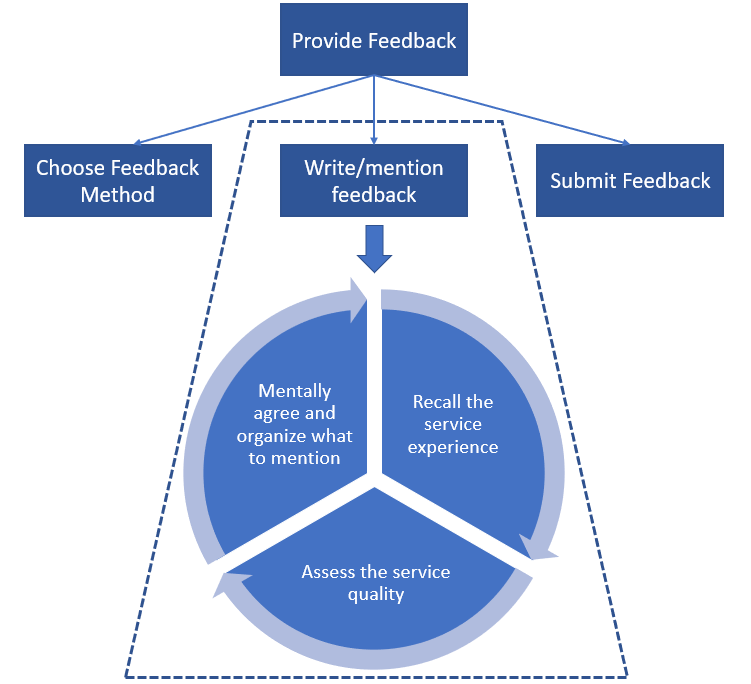
- Recall the service experience (memory)
- Assess the service quality (reasoning and emotion)
- Mentally agree on and organise what to mention (decision)
The user may loop through these several times. A processor model would see only "typing". CTA reveals the thinking that a good design should support, for example with prompts like "How was the delivery speed?"
4Hierarchical Task Analysis (HTA)
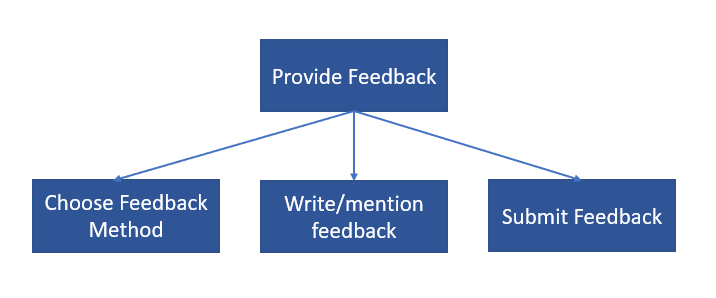
HTA breaks high-level goals into nested sub-tasks, basic operations and plans. It can be written as text or drawn as a tree diagram. Usually you do the textual version first 00:00.
Textual HTA
0. Provide feedback
   1. Choose feedback method
   2. Write / mention feedback
      2.1 Open email          ┐ email branch
      2.2 Write email         ┘
      2.3 Open form           ┐ form branch
      2.4 Fill form           ┘
   3. Submit feedback
      3.1 Send email (click Send)
      3.2 Submit form (click Submit)

Plan 0: do 1 – 2 – 3 in order
Plan 2: IF method = email THEN do 2.1, 2.2 in order ELSE do 2.3, 2.4 in order
Plan 3: IF method = email THEN do 3.1 ELSE do 3.2
A plan says in what order, and under what condition, the sub-tasks are done. At any time either 2.1 + 2.2 or 2.3 + 2.4 is done, never both 02:35.
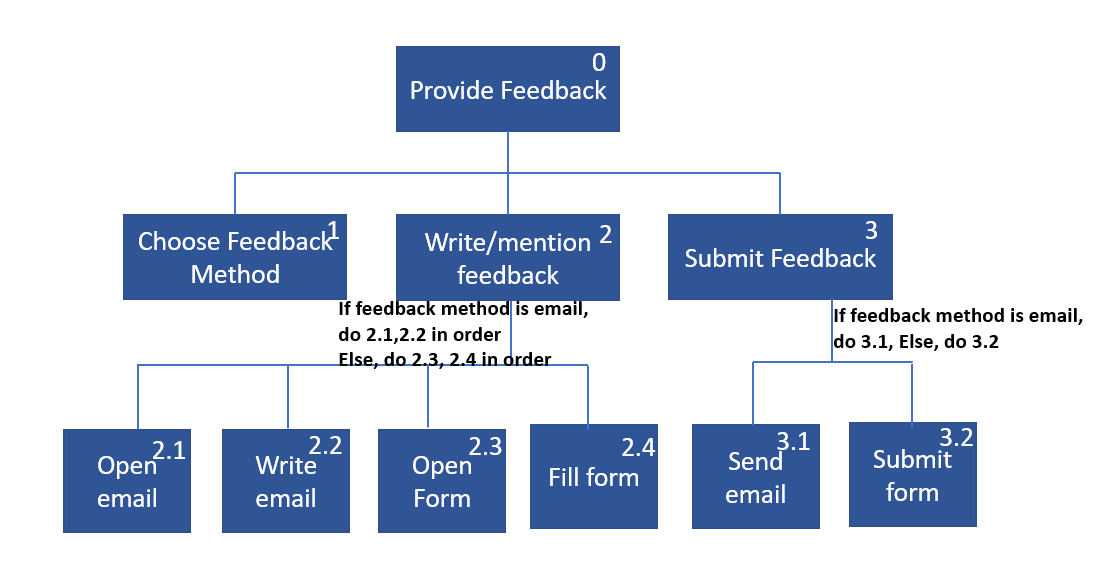
Reading the diagram: top to bottom, left to right 03:51
Start at the root and go down. At each node, finish all its sub-branches before moving right. Where a plan has a choice, follow only the chosen branch, then come back up and continue right.
An alternative decomposition (View 2)
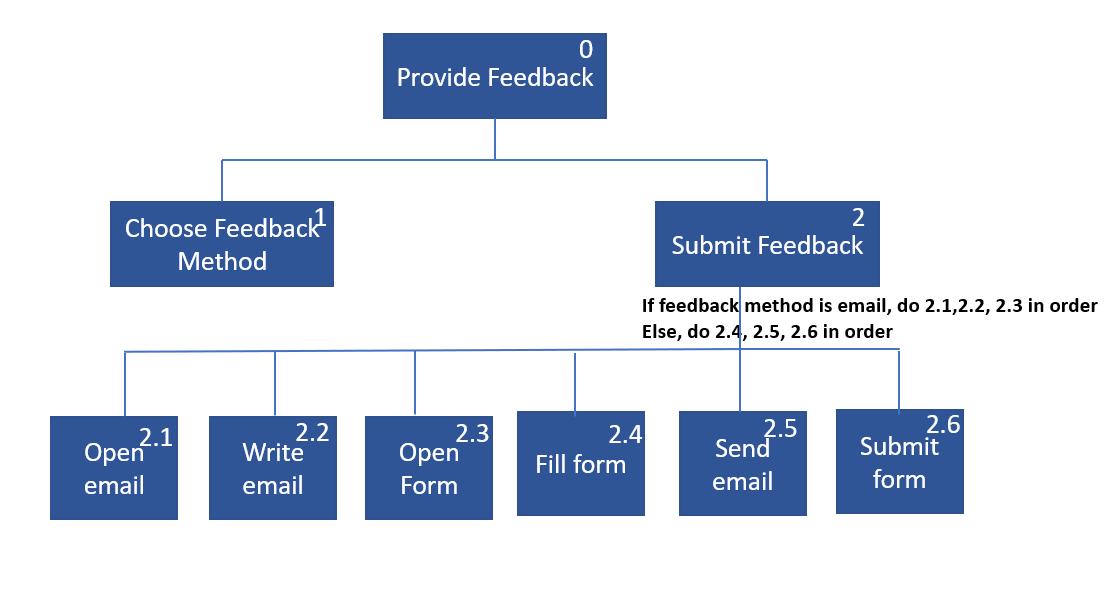
The same goal can be broken down differently. The PDF's second view puts writing inside submitting:
0. Provide feedback
   1. Choose feedback method
   2. Submit feedback
      2.1 Open email   2.2 Write email   2.3 Send email
      2.4 Open form    2.5 Fill form     2.6 Submit form
Plan 2: IF email do 2.1–2.3 ELSE do 2.4–2.6
Different analysts produce different but valid hierarchies. What matters is that the decomposition is complete, the plans are clear, and it matches how users really work.
5Modularity & divide and conquer
Breaking tasks into structured sub-tasks reveals universal modular patterns that transfer across applications:
🛒 E-commerce checkout
Every online store uses the physical metaphor of a shopping cart and checkout counter. Because this sub-task is standardised, vendors can embed existing payment widgets (PayPal, Stripe) instead of reinventing them.
🧩 Divide & conquer in UI design
Hierarchy enables abstraction. Designers can isolate solved sub-problems (login, search, checkout), reuse them, and spend their creativity on what makes their product unique.
Typical questions:
- "Differentiate processor- and predictor-oriented models"
- "Explain the 5 steps of CTA"
- "Draw a textual and diagrammatic HTA (with plans) for task X", e.g. withdrawing cash from an ATM or booking a ticket
Always number the nodes (1, 1.1, 1.2…), write the plans, and remember top to bottom, left to right.
6Quick revision sheet
| Concept | Remember it as |
|---|---|
| Processor-oriented | Behaviourism; observable actions (GOMS) |
| Predictor-oriented | Cognitivism; hidden reasoning, memory, attention |
| CTA | Uncovers invisible cognition |
| 5 steps | Collect → Identify representations → Populate (think-aloud) → Verify with users → Format for design |
| Feedback stream | Recall experience → Assess quality → Organise what to say |
| HTA | Goal → sub-tasks → operations + plans; textual first, then diagram |
| Plan | Order and conditions (IF email THEN 2.1, 2.2 ELSE 2.3, 2.4) |
| Traversal | Top to bottom, left to right; finish sub-branches first |
| Modularity | Standard sub-tasks (checkout, login) can be reused (PayPal, Stripe) |
?Self-check quiz
10 questions on this week. Answer them all, then press Check my answers. Your best and latest scores are saved and shown on the subject page.